
A practical guide to understanding cost centres, avoiding double charging, and preventing unnecessary ledger splits. This article explains how smarter expense allocation leads to clearer, more accurate strata financial reports.

A Practical Guide to Clearer, More Accurate Strata Financial Reporting
Strata financial reports are only useful when the way expenses are allocated makes sense. Two issues commonly reduce clarity in strata accounts: misunderstanding how cost centres relate to each other, and over-splitting expenses across multiple general ledgers. These issues arise simply because cost centres and ledgers are technical tools. Anyone who is unfamiliar with how they interact can unintentionally create splits that distort the financial picture.
This guide explains how cost centres are structured, why certain splits lead to double charging, and why breaking fixed costs into multiple ledgers often adds complexity without improving insight.
Cost centres separate financial activity for groups of lots that do not share the same financial obligations. A broad cost centre typically includes all lots in the scheme, while subset cost centres include only specific groups such as residential, commercial or retail.
A simple way to understand cost centres is to think of them as sets in mathematics.
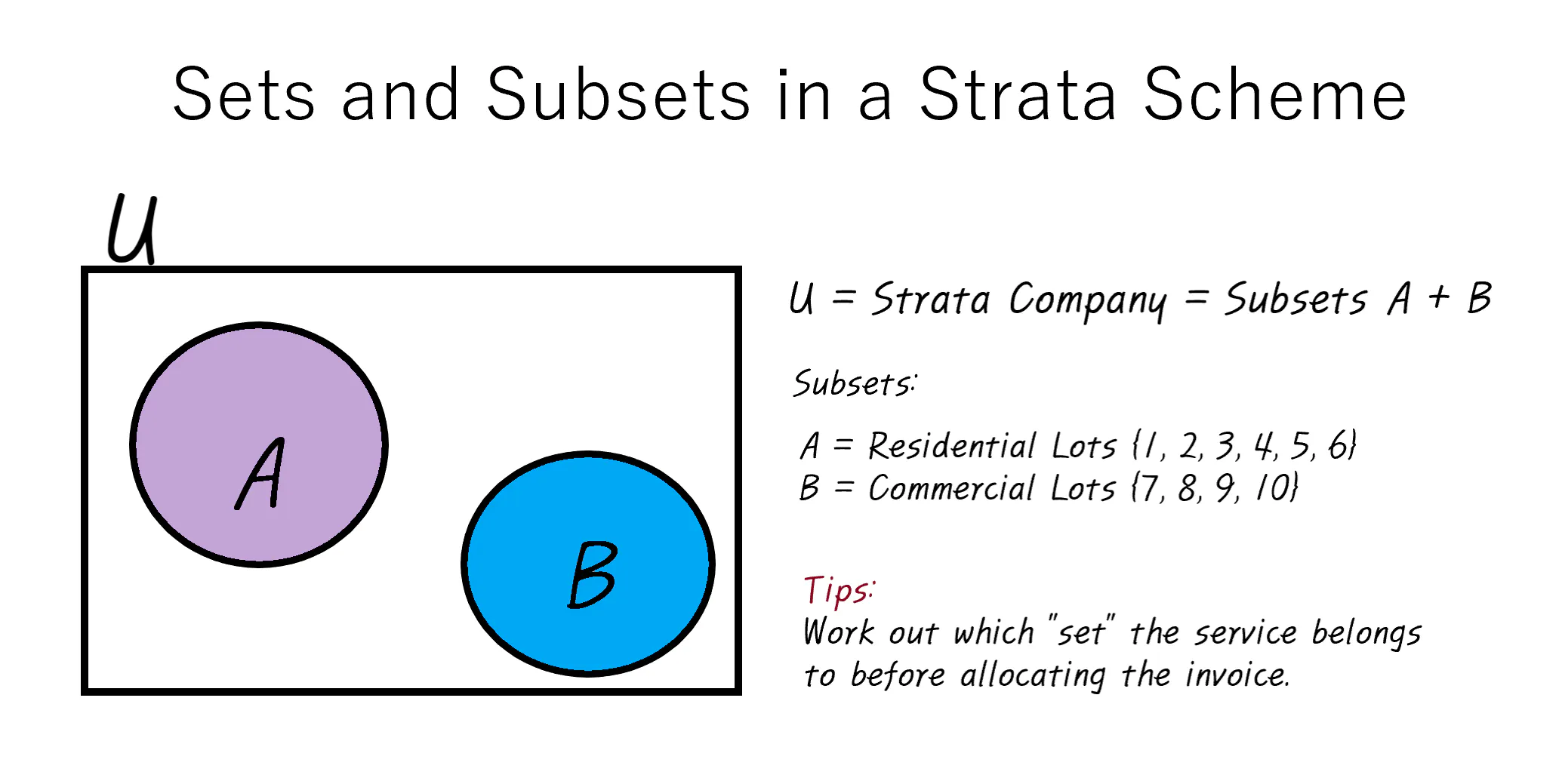
The broad cost centre is the full set because it includes the union of lots.
Residential, commercial and any other cost centres sit as subsets of that full set.
If a subset sits inside the full set, then every lot in the subset is already included in the broad cost centre. If an expense is split between the set and its subset, the subset is charged twice: once through the broad cost centre and again through the subset. This is why splitting between a broad cost centre and a subset cost centre always leads to double charging.
There are situations where splitting by cost centre is appropriate. Cleaning is a good example. In a building with multiple floors or distinct areas, cleaning costs may need to be allocated by section. A portion may relate to shared common areas, while other portions relate entirely to residential, commercial or other zones. In these cases, the split reflects genuine differences in who benefits from the service.
The most frequent error occurs when an expense is split between a broad cost centre and a smaller subset cost centre. This usually happens because the person performing or requesting the split does not realise that the subset is already included in the broader group.
Consider a scheme where residential lots hold 800 out of 1,000 units of entitlement and commercial lots hold the remaining 200. The broad cost centre includes every lot in the building. The subset cost centre includes only the residential lots.
A contractor invoice of $5,000 is split as 30 percent to the broad cost centre and 70 percent to the residential cost centre. Because the residential lots appear in both cost centres, they end up paying $4,700 of the invoice while commercial lots pay only $300. Residential lots effectively fund 94 percent of the cost.
This outcome is not intentional. It is simply the result of misunderstanding how cost centres are structured. Any time an expense is split between a broad cost centre and a subset cost centre, the subset will always be charged twice.
Tip: Identify which set the service belongs to before splitting the invoice to avoid incorrect allocations.
Over-splitting often happens because it feels more precise. Breaking one invoice into several categories can look like better reporting, but it rarely improves understanding. The financial report is clearer and easier to follow when a fixed cost sits in one meaningful ledger.
A common example is a caretaker or building manager who charges the same fixed amount every month. Sometimes this fee is split into ledgers such as gardening, general maintenance and rubbish removal. The intention is to show multiple tasks. The issue is that the amount never changes. The same figure is simply divided into the same proportions every month, which adds detail without adding insight.
The exception to this is the cleaning example described earlier. Splitting is appropriate when the work genuinely differs by area or section, and the cost reflects those differences.
The key distinction is whether the cost varies because the work varies. If the caretaker performs extra gardening one month or completes a specific repair, allocating those variable costs to the relevant ledger makes sense. It reflects actual activity. But when the fee is fixed and identical each period, splitting it into multiple ledgers adds nothing. It increases the number of lines in the report and makes trends harder to see.
Over-splitting also increases the risk of coding errors. More lines mean more opportunities for mistakes. A single misallocation or GST error can distort the accounts and require correction later.
The principle is simple. A cost should only be split when the split provides meaningful information. If the cost is fixed, predictable and identical each period, splitting it into multiple ledgers adds complexity without adding value.
Materiality protects councils from drowning in detail. If splitting an expense does not change a decision, it is not material. Materiality should guide how many general ledgers exist, when expenses are split and how cost centres are used. It is a governance principle, not an accounting rule.
The right level of detail is the level that supports decision making. Not more. Not less. A good financial report shows trends, highlights variances, supports budgeting, is easy to read and easy to explain. Splitting expenses should support these outcomes. If it does not, it should not be done.
Clear financial reporting depends on understanding how cost centres and general ledgers work. Misunderstanding cost centre structure can lead to double charging. Over-splitting fixed costs can create noise without adding insight. Splitting expenses is only useful when it improves fairness, accuracy or decision making. Most micro splitting does not. It creates complexity without improving governance.
Purposeful categories, consistent structure and disciplined allocation create financial reports that genuinely support decision making and help councils understand the true cost of running their scheme.