
A balanced bank account does not necessarily mean the underlying strata accounts are correct. Two real-life bond examples show why understanding the substance of a transaction is just as important as reconciling the cash at bank.
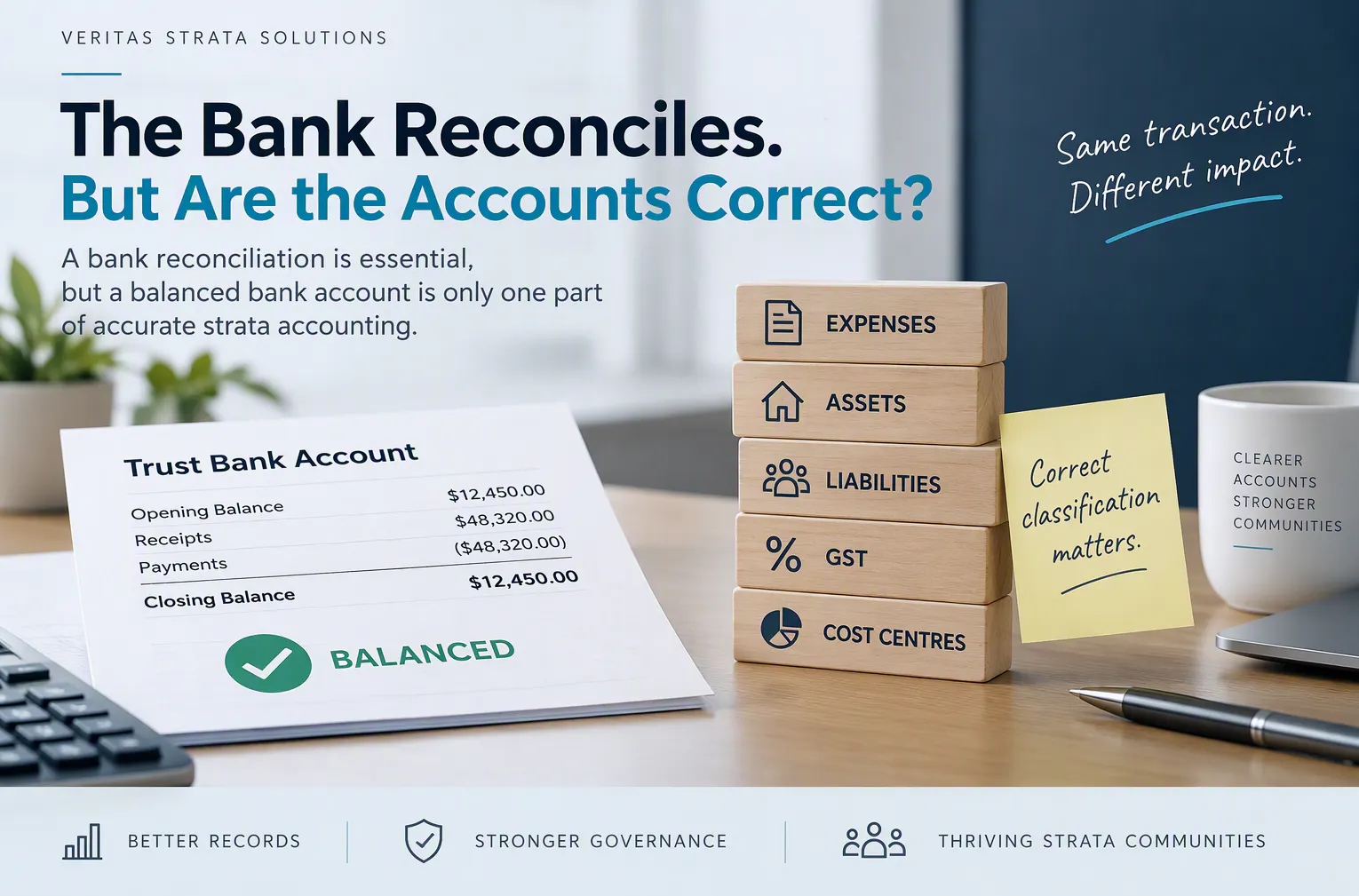
A bank reconciliation is an essential financial control, but a balanced bank account is only one part of accurate strata accounting. The transactions behind the balance still need to be understood and classified correctly.
Seeing a trust bank account fully reconciled can provide reassurance that the accounts are in order. But reconciliation and accuracy are not the same thing.
A bank reconciliation confirms that transactions recorded in the accounting system reconcile to the bank. It does not confirm that every transaction has been classified correctly.
A transaction can be recorded for the correct amount but allocated to the wrong account, fund, cost centre or lot. An asset can be recorded as an expense, or a liability as an asset, without preventing the bank account from reconciling.
The bank can balance perfectly while the financial reports are still wrong.
A bank reconciliation answers:
Has the movement of money been accounted for?
It does not necessarily answer:
Has the movement of money been accounted for correctly?
That requires an understanding of what the transaction actually represents.
Two real-life examples involving bonds demonstrate why the substance of a transaction matters.
Both were described as a “bond”, but they represented very different things.
While working through the financial records during an onboarding, I noticed a payment to the Bond Administrator that stood out.
The Strata Company was paying rent for the building manager's residence, and a rental bond had also been paid. Both the rent and the bond had been recorded as expenses.
The rent was a cost to the Strata Company. The rental bond was different. It was refundable and recoverable subject to the relevant conditions.
The rental bond should therefore have been recognised on the Balance Sheet as an asset, rather than as an operating expense.
Nothing in the bank reconciliation would necessarily have highlighted the issue. The correct amount had left the trust bank account and had been recorded.
The payment caught my attention because of who it was paid to. Understanding why it was paid revealed the incorrect classification.
In another case, a bond had been recorded as an asset. However, the records handed over did not explain what the bond represented.
The account name alone was not enough. After contacting the previous manager to clarify the nature of the transaction, I established that the construction bond had been paid by two lot owners to the Strata Company. It was being held while the owners were constructing their survey-strata building and could be returned on completion, provided there was no damage to common property.
The Strata Company had therefore received money that it could have an obligation to return. The bond should have been recognised on the Balance Sheet as a liability, rather than as an asset.
Without asking the question, the reason behind the balance would not have been clear.
Again, the bank could reconcile correctly. The cash had been recorded. What was missing was the context needed to classify it correctly.
A matching account name does not necessarily mean it is the right account for the transaction. If a transaction contains the word “bond”, it can be tempting to select an existing account that also contains “bond”. But the substance of the transaction should determine where it belongs.
In these examples:
Rental bond paid by the Strata Company:
Money recoverable by the Strata Company, therefore an asset.
Construction bond received from an owner:
Money potentially repayable by the Strata Company, therefore a liability.
Before selecting an account, consider:
The transaction should determine the account. The account name should not determine the transaction.
In day-to-day strata finance, strong bookkeeping skills are just as important as accounting knowledge, particularly when getting transactions right at the source.
Good bookkeeping is not simply finding a familiar account name in the Chart of Accounts. It means understanding what happened first and then deciding where the transaction belongs.
Only then can it be classified against the appropriate account, fund, cost centre, lot and GST treatment.
A balanced bank account tells you the money is accounted for. Good bookkeeping tells you whether it has been accounted for correctly.
Reliable strata accounts require more than a reconciled bank.
The Balance Sheet should contain balances that can be explained. Income and expenses should be meaningfully classified. Owner positions should reflect the correct transactions. GST accounts should reconcile, and fund and cost centre allocations should reflect where transactions genuinely belong.
None of these issues necessarily prevents the bank account from balancing.
The cash movement can be correct. The bank can reconcile. But the financial reports can still tell the wrong story.
This becomes particularly important when a Strata Company changes management.
A reconciled incoming bank balance does not automatically mean the underlying balances, transactions or Chart of Accounts are correct.
Opening balances may contain historical adjustments, outstanding invoices, owner positions, GST balances, bonds, deposits and other assets or liabilities that need to be understood.
If a balance does not make sense, simply carrying it into the incoming records carries the question forward.
A reliable starting position requires the supporting accounts to reflect what those balances actually represent.
A balanced bank account is important, but reconciliation cannot determine the nature of every transaction. Neither can the name of an account in the Chart of Accounts.
That requires understanding the substance behind the entry.
The two bond examples demonstrate this clearly. Both were called a “bond”, but one represented money recoverable by the Strata Company while the other represented money potentially repayable by the Strata Company.
The label was similar. The financial substance was not.
Before asking:
“Which account should I code this to?”
First ask:
“What does this transaction actually represent?”
Once the substance is understood, the appropriate classification becomes much clearer.
Good strata bookkeeping is not simply about making the numbers balance. It is about understanding the transaction well enough to put the right number in the right place.